Dental Diagnostic Instruments
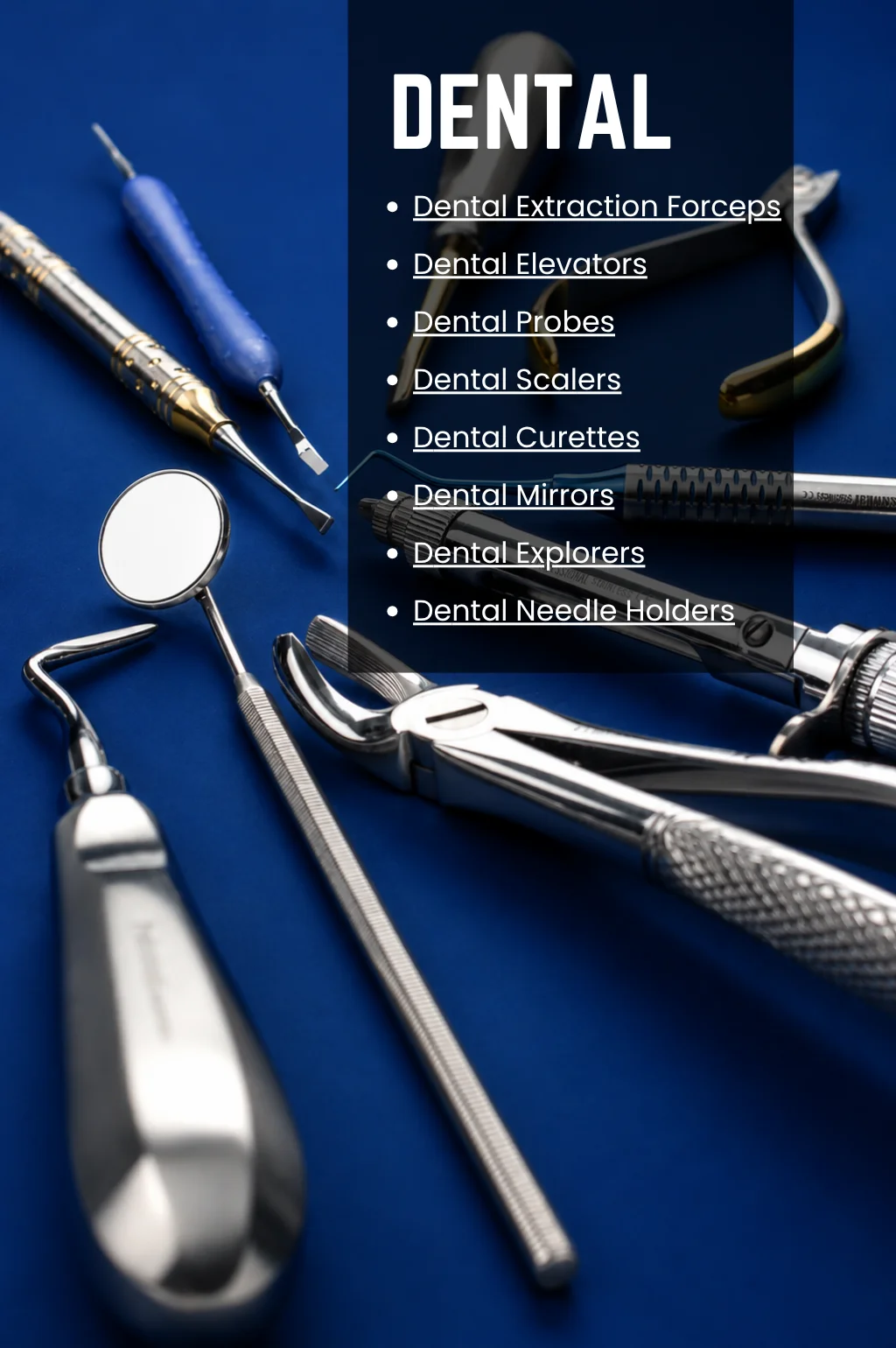
Dental diagnostic instruments are the hand instruments a dentist uses to look inside the mouth and assess the teeth and gums during an examination. The core set is the mouth mirror, the dental explorer, the periodontal probe, and cotton pliers, often with tweezers and a tongue or cheek retractor.
The mouth mirror reflects operatory light onto hidden surfaces, gives the dentist an indirect view of the back of the teeth, and holds the cheek and tongue away from the working area. The dental explorer, such as the shepherd's hook and the right angle explorer, has a thin sharp tip that catches on soft decayed enamel and checks the margins of fillings. The periodontal probe is marked in millimetres and measures the depth of the gum pocket around each tooth, and the Nabers probe follows the furcation between roots. Cotton pliers grip and carry cotton pellets, paper points, and small materials in and out of the mouth. Used together these instruments find decay, record pocket depths for periodontal charting, and build the picture a dentist needs to plan treatment.
Periodontal and Soft Tissue Instruments
Periodontal and soft tissue instruments remove hard deposits from the teeth and treat the gums and the tissues that hold the teeth in place. The family includes sickle scalers, Gracey and universal curettes, periodontal files such as the Hirschfeld file, periodontal hoes, periodontal chisels, and gingivectomy knives such as the Kirkland knife and the Orban knife.
Sickle scalers have a pointed tip that lifts hard calculus off the crown above the gumline. Curettes have a rounded toe and work below the gumline, where the Gracey curettes are angled for set groups of teeth and the universal curette adapts to most surfaces, both used for subgingival scaling and root planing without cutting the soft tissue. Periodontal files and hoes crush and pull away stubborn calculus, periodontal chisels clear deposits from between the front teeth, and gingivectomy knives trim and reshape gum tissue during periodontal surgery. These instruments come in matched left and right patterns and in several blade angles so the dentist can reach the front teeth, the back teeth, and the furcation areas between the roots.
Dental Restorative Instruments
Dental restorative instruments carry, pack, shape, and finish the materials that rebuild a damaged tooth. The family includes amalgam carriers, condensers and pluggers, ball burnishers, carvers such as the Hollenback carver and the discoid cleoid carver, composite placement instruments, cement spatulas, and matrix instruments such as the Tofflemire matrix retainer.
The amalgam carrier moves the filling material into the prepared cavity, and the condenser packs it firmly against the walls and floor. Carvers cut the chewing surface back into shape, and the ball burnisher smooths the surface and seals the margins. Composite placement instruments spread and contour tooth coloured filling material, cement spatulas mix and place lining and luting cements, and the matrix retainer holds a metal band around the tooth so the dentist can rebuild the wall and the contact point between two teeth. Each working end is shaped for the material in use, whether amalgam, composite, glass ionomer, or cement.
Endodontic Instruments
Endodontic instruments reach into the root canal to clean, shape, and fill the space left after the pulp is removed during root canal treatment. The family includes endodontic explorers such as the DG16, long shank spoon excavators, root canal pluggers, and root canal spreaders, along with the hand instruments that support each step.
The endodontic explorer finds the canal openings on the floor of the pulp chamber. The long shank excavator reaches deep into the access cavity to lift out pulp tissue and decay. The spreader presses sideways to make room for extra filling points during lateral compaction, and the plugger presses the filling material down to seal the canal. Because the canal is narrow and curved, these instruments need a fine accurate tip and enough strength for the dentist to keep full control inside the tooth.
Orthodontic Instruments
Orthodontic instruments place the brackets and bands, shape and cut the wire, tie in the ligatures, and adjust the braces at each visit. The family includes ligature cutters, distal end cutters, bird beak pliers, Weingart pliers, bracket positioning instruments, band seaters, Howe pliers, and loop forming pliers such as the Tweed loop pliers.
The distal end cutter trims the wire behind the last tooth and holds the cut piece so it does not fall, and the ligature cutter snips the thin wire ties. Bird beak pliers and loop forming pliers bend the precise curves, stops, and loops the wire needs, while Weingart pliers and Howe pliers carry and seat the wire and the brackets. Each plier is built for a set wire thickness and bracket system, which gives the orthodontist clean control over every bend, cut, and placement during treatment.
Oral Surgery and Extraction Instruments
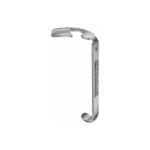
Oral surgery and extraction instruments remove teeth, work on the bone, and handle the soft tissue during surgery. The family includes extraction forceps, straight and angled dental elevators such as the Cryer and Warwick James elevators, luxators, root tip picks, periosteal elevators such as the Molt elevator, surgical curettes, bone rongeurs, bone files, tissue forceps, Mayo Hegar needle holders, surgical scissors, mosquito hemostatic forceps, and cheek and Minnesota retractors.
The dentist works an elevator or a luxator between the tooth and the bone to cut the periodontal ligament and loosen the tooth, then grips the tooth with extraction forceps to lift it out. Extraction forceps come in separate patterns for the upper and lower jaw and for the front and back teeth, each one shaped to fit a particular tooth. Root tip picks lift out broken root fragments, the periosteal elevator raises the gum flap off the bone, rongeurs and bone files cut and smooth bone, and the tissue forceps, needle holder, scissors, and retractors hold the tissue and close the wound with sutures.
Prosthodontic and Laboratory Instruments
Prosthodontic and laboratory instruments take impressions, build and trim models, and shape and fit crowns, bridges, and dentures. The family includes impression trays, wax carving instruments such as the Le Cron carver and the wax knife, plaster and wax spatulas, plaster knives, and articulating paper holders.
The impression tray holds the impression material against the teeth to copy the exact shape of the arch. The wax knife and the Le Cron carver shape the wax pattern for a crown or denture, the plaster spatula mixes and pours the model material, and the plaster knife trims the set stone model. The articulating paper holder marks the spots where the upper and lower teeth meet so the dentist can adjust the bite. Because the laboratory reuses these instruments on case after case, they are built to hold a steady shape and a firm working end.
Clinical Applications of Dental Instruments
Across these specialties, dental instruments carry out the oral examination, periodontal charting, scaling and root planing, cavity preparation and filling, root canal treatment, tooth extraction, gum and soft tissue surgery, bracket and wire placement, impressions and crown and denture work, implant site preparation, and the suturing that closes a surgical wound.
General dentists, oral and maxillofacial surgeons, periodontists, endodontists, orthodontists, prosthodontists, dental hygienists, and surgical assistants use these instruments every day in dental clinics, hospitals, and specialist practices around the world.
Instrument Design, Patterns, and Working Ends
Dental instruments in the same family differ mainly in their working end, their length, their curve, and their handle. The working end is the part that touches the tooth or tissue and decides what the instrument does, whether that is a sharp point, a rounded blade, a beak, a plugger, or a cutting edge. The length and the curve decide how far back in the mouth and how deep along the root the instrument can reach.
Many dental instruments are double ended, with a matched or opposite working end at each tip so one instrument does the work of two. Handles are made solid, hollow, and textured to balance weight, control, and grip in the dentist's hand. This is why one instrument type, such as a scaler, a curette, or an extraction forceps, exists in many separate patterns, each one made for a particular tooth, surface, or step in a procedure.
Materials and Manufacturing
Reusable dental instruments are made mostly from surgical stainless steel and from titanium. Cutting instruments such as scalers, curettes, and carvers are made from hardenable stainless steel that takes and holds a sharp edge, while instruments that do not cut, such as probes, retractors, and forceps, use a tougher corrosion resistant steel chosen for strength and a stable shape. Titanium is used where light weight and strong corrosion resistance matter.
The instrument moves through forging, machining, grinding, polishing, assembly, and inspection, and each step sets the size, the working end shape, and the finish. The finish is chosen for a reason. A satin or matte finish cuts the glare from the operatory light, and a mirror polish resists deposits and corrosion on the surface. Sound steel and a controlled finish are what let a dental instrument keep its shape, its edge, and its function through repeated clinical use.
Dental Instruments Manufactured in Sialkot, Pakistan
Sialkot in Pakistan is one of the largest centres in the world for making reusable surgical and dental instruments. The city has a skilled workforce trained over generations, settled supply chains for steel and components, and factories built for export. Dental instruments made in Sialkot reach hospitals, distributors, healthcare groups, and OEM partners across many countries.
Rahmet Group of Surgical Industries makes reusable dental instruments in Sialkot for OEM manufacturing, private label programs, wholesale supply, and worldwide distribution, across the full set of diagnostic, periodontal, restorative, endodontic, orthodontic, surgical, and prosthodontic instrument families.

 (+92)3076495862
 info@rahmetgroup.com